

Applied Engineering Technology Career Academy
New in 2025! The applied engineering technology career academy develops students’ technical skills in the maintenance and repair of mechanical and electronic equipment. This program is designed to develop skills in various areas of manufacturing and troubleshooting while looking on from an engineering perspective. The applied engineering technology career academy is located in Osceola, at the ORBIT (Osceola Regional Business and Industrial Technology) Center, which is located directly west of the SWCC Osceola Center.
Year 1 - Fall
EGT 114 Introduction to Engineering Technology - 3 credits
ELE 110 Basic Electrical Fundamentals - 3 credits
ELE 172 Fundamentals of Fluid Dynamics - 3 credits
MGT 516 Introduction to Lean Manufacturing - 2 credits
Year 1 – Spring
ELT 170 Introduction to PLCs - 3 credits
ELT 793 Advanced Fluid and Power - 3 credits
ELE 195 Motor Control - 3 credits
Instructor: Shawn Oaks
To explore SWCC’s associate degree applied engineering technology program, please visit Applied Engineering Technology @ SWCC!
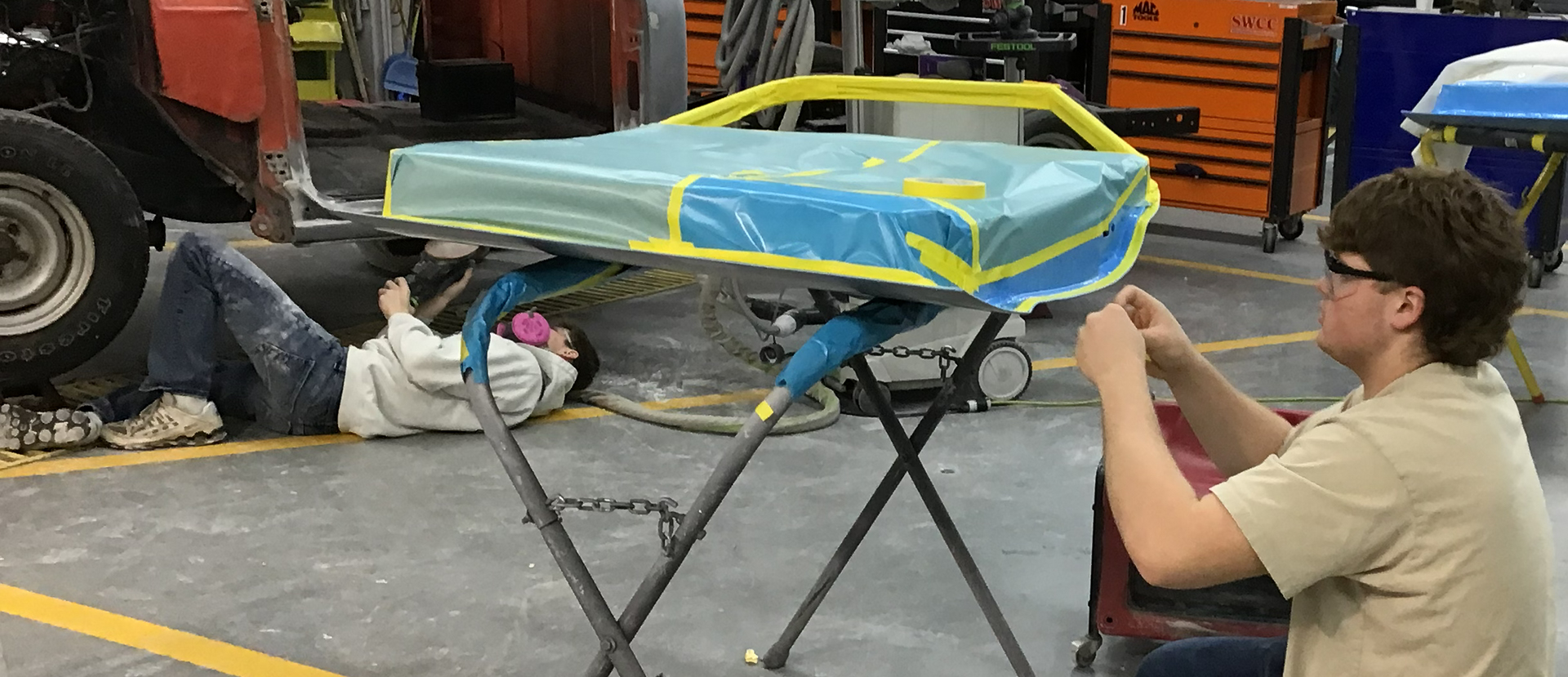
Auto Collision Repair/Refinish Career Academy
If you're looking for a rewarding career in the auto industry, SWCC's auto collision repair/refinish career academy program is an excellent place to get started. The program is held on the SWCC Creston campus. Students are trained in areas of panel straightening, refinishing, structural and non-structural repair, plastics repair, welding, mechanical repairs, and estimating. Quality workmanship is the focus of SWCC's auto collision repair program.
Auto Collision Repair/Refinish Course Sequence
Year 1 – Fall
CRR 301 Introduction to Collision Repair - 1 credit
CRR 101 Sheet Metal Welding - 2 credits
CRR 804 Introduction to Refinishing - 4 credits
Year 1 – Spring
CRR 201 Plastic Repair - 2 credits
CRR 743 Estimating - 3 credits
CRR 833 Refinishing II - 3 credits
Year 2 – Fall
CRR 324 Sheet Metal Fundamentals - 4 credits
CRR 420 Non-Structural Repair - 4 credits
Year 2 – Spring
CRR 504 Frame and Unibody Damage Analysis - 4 credits
CRR 361 Collision Lab I - 4 credits
Program instructor: Jeff Magneson
To explore SWCC's associate degree auto collision repair/refinish program, please visit Auto Collision Repair/Refinish @ SWCC!

SWCC CEP
Opportunities for high school students to earn college credit are available at a number of districts throughout the college's region - SWCC CEP Course Offerings. A SWCC CEP course is taught at the high school by a high school instructor who meets SWCC’s instructor qualifications. Enrollment in a concurrent enrollment course generates an official college transcript for each student where grades, withdrawals, etc. are recorded.
SWCC was awarded National Alliance of Concurrent Enrollment Partnerships (NACEP) accreditation in 2012. NACEP is a professional organization for high schools and colleges that fosters and supports rigorous concurrent enrollment. NACEP serves as a national accrediting body and supports all members by providing standards of excellence, research, communication, and advocacy. NACEP defines concurrent enrollment as the subset of dual enrollment courses taught by college-approved high school teachers.
High school teachers looking to become approved SWCC CEP instructors can contact
The following checklist will serve as a guide to take classes through SWCC’s Concurrent Enrollment Program:
- Students must meet proficiency requirements as evidenced by standardized test or alternative measure of proficiency as approved the local district’s Board of Education.
- Students must also meet the same admission and placement policies as traditional college students, as outlined in the SWCC College Catalog & Student Handbook.
- Students must complete the Southwestern application for admission
- Students must complete their high school’s respective registration form (available from your school counselor.) If a student is under 18, a parent or guardian must also sign the form.
- Students must complete the ACCUPLACER test by the first day of SWCC classes (unless the student has a documented score of 19 or higher on his/her ACTs).
- If a student does not meet the eligibility requirements after taking the ACCUPLACER, the high school may recommend the student be allowed to take the course by completing the SWCC High School Acceptance of Responsibility Form.
- Receive approval from the Southwestern secondary programs director for course selection and registration.
Concurrent Enrollment classes follow the respective school district’s academic calendar for meeting dates. All other important dates will follow Southwestern’s schedule.
Student Resources
- How to Access the SWCCyou Portal - Login to SWCCyou to view class schedule, midterm and final grades, unofficial transcript, and demographic profile.
- Webmail: Access your SWCC Email Account
- Educational Equity Statement
- Transcript Request
- Transition To College
- SWCC College Catalog & Student Handbook
- SWCC Course Schedule
- College Connection Student Manual
SWCC CEP Course Offerings
The listings below detail which CEP courses are offered at each of the high schools in Southwestern Community College's region. Course descriptions for these classes are listed below or may be viewed in the SWCC College Catalog & Student Handbook.
Bedford High School
- CSC 110 Introduction to Computers, 3 credits. Prerequisite: Keyboarding skills. This is an introductory course that surveys a variety of topics to include history, hardware, software, terminology, communications, computer ethics, and societal impact of computers. In addition to computer literacy, students will complete hands-on modules for Microsoft Office programs.
- BUS 102 Introduction to Business, 3 credits. An introduction to the functions and practices of modern business and the economic institutions that facilitate the operation of individual business units. The interrelations existing in the various phases of business activity: organization, finance, production, and marketing.
Central Decatur High School
- CON 141 Basic Construction Skills, 2 credits. This course provides students with the basics in construction including math, safety, blueprint reading, hand and power tools, employability skills, and materials handling.
- CON 155 Carpentry Level I, 3 credits. This course will provide a fundamental overview of the carpentry trade. Students will gain a basic knowledge of construction materials, hand and power tools, and rough framing. Other course topics include plan reading, window and exterior door installation, and basic concrete practices.
- CON 183 Construction Lab IA, 5 credits. This course provides students a hands-on application in the basics in construction including math, safety, blueprint reading, hand and power tools, employability skills, and materials handling.
- CON 184 Construction Lab IB, 5 credits. This course provides hands-on experience in the construction of a residential home. Students will demonstrate basic knowledge of construction materials, hand and power tools, rough framing, plan reading, window and exterior door installation, and basic concrete practices.
- IND 114 General Industry Safety, 1 credit. This course provides instruction on general industry safety and health topics. The course will provide students with the knowledge to recognize the hazards of the workplace and to work safely in or around such hazards.
- WEL 111 Welding Blueprint Reading, 3 credits. A course concerned with basic fundamentals of interpreting drafting as applied in the welding trade. Emphasis is placed on developing the ability to interpret blueprints from which the welder must work. Special emphasis is placed on lines, views, material descriptions, welding symbols, and terms.
- WEL 114 Introduction to Fabrication, 3 credits. This course develops the skills needed in a manufacturing atmosphere such as tool usage, layout methods and material estimating.
- WEL 162 Introduction to Shielded Metal Arc Welding (SMAW), 3 credits. This course provides a thorough technical understanding of shielded metal arc welding fundamentals, weld hazards and weld safety, power sources and electrode selection. Provides ample time and direction to develop skills necessary to make high quality welds on 16 gauge to 1/4" mild steel in all positions.
- WEL 225 Introduction to Gas Metal Arc Welding, 3 credits. This course provides a technical understanding of the gas metal arc welding process, power sources and adjustment, metal transfer, shielding gases and weld safety. It also develops skills necessary to produce high quality welds of 1/16" to 3/8" mild steel in all positions. Students will develop skills necessary to produce and bend test single V-groove welds on 3/8" carbon steel in all positions according to American Welding Society code of requirements.
Clarke High School
- ART 101 Art Appreciation Art Appreciation, 3 credits. An introduction to the visual arts and explores the nature of art and the mechanisms of creativity, the materials and methods of making art, the purpose of art in various cultures both ancient and contemporary, and the significance of visual literacy in today’s world.
- AGS 112 Survey of the Animal Industry, 4 credits. Introduces students to the various species and breeds of domestic animals and to create an understanding of the principles of food animal production, product marketing, and issues confronting the animal industry.
- CON 141 Basic Construction Skills, 2 credits. This course provides students with the basics in construction including math, safety, blueprint reading, hand and power tools, employability skills, and materials handling.
- CON 155 Carpentry Level I, 3 credits. This course will provide a fundamental overview of the carpentry trade. Students will gain a basic knowledge of construction materials, hand and power tools, and rough framing. Other course topics include plan reading, window and exterior door installation, and basic concrete practices.
- CON 183 Construction Lab IA, 5 credits. This course provides students a hands-on application in the basics in construction including math, safety, blueprint reading, hand and power tools, employability skills, and materials handling.
- CON 184 Construction Lab IB, 5 credits. This course provides hands-on experience in the construction of a residential home. Students will demonstrate basic knowledge of construction materials, hand and power tools, rough framing, plan reading, window and exterior door installation, and basic concrete practices.
- CON 189 Construction Lab IIB, 5 credits. This course provides hands-on experience in the construction of a residential home. The intent of this course is to provide students with the knowledge to install and finish drywall, install doors and windows, install suspended ceilings and install cabinets.
- CON 267 Construction Level IIB, 2 credits. Carpentry Level IIB is designed to provide students with knowledge and information in preparation to handle the work requirements in the construction trades. The intent of this course is top provide students with the knowledge in drywall installation and finishing, installation of doors and windows, the installation of suspended ceilings as well as the installation of cabinets.
- EDU 213 Introduction to Education, 3 credits. Prerequisite: ENG 105 Composition I is highly encouraged. This introductory course in education will provide opportunities for the student to gain a fundamental understanding of what is involved in a teaching career. Topics include, but are not limited to, current issues in education, school law, and ethics. Also, it is designed to familiarize students who may not enter the teaching profession with some basic educational principles which will enable them to contribute more adequately to the total educational system. Students will be required to complete 15 hours of observation in a K-12 classroom as part of this course.
- EDU 245 Exceptional Learner, 3 credits. This course provides an overview of special education regulations, policies and programs in educational settings. K-12 pre-service teachers learn the history of special education law, including IDEA and as it applies to NCLB, characteristics of the eight categories of disability per federal and state regulations, characteristics of talent and gifted programs, and basic component of an IEP. This course is a required component for students seeking K-12 teacher state licensure.
- MAT 120 College Algebra, 3 credits. Prerequisite: Recommended COMPASS/ ACCUPLACER score or MAT 101 Intermediate Algebra. Topics to include: the real and complex number systems and Cartesian coordinate system. Additional concepts include polynomial, exponential, and logarithmic functions as well as matrix algebra, systems of equations, conic sections and sequences/series.
- MAT 127 College Algebra and Trigonometry, 3 credits. Prerequisite: Recommended COMPASS/ ACCUPLACER score or MAT 101 Intermediate Algebra. Topics to include: the real and complex number systems and Cartesian coordinate system, also polynomial, exponential, logarithmic, and trigonometric functions, matrix algebra, systems of equations, conic sections, and sequences/series.
- MAT 156 Statistics, 3 credits. Prerequisite: Recommended COMPASS/ ACCUPLACER score or MAT 101 Intermediate Algebra. Statistics is a non-calculus based course designed to lay a foundation which will enable students to understand statistical thinking and apply basic statistical techniques. The qualitative and quantitative study in statistics will be useful for students pursuing majors in a wide variety of disciplines: psychology, sociology, business, economics, physical science, biological science, education, engineering, journalism, and career and technical programs.
- MAT 210 Calculus I, 4 credits. Prerequisite: Recommended COMPASS/ ACCUPLACER score or MAT 127 College Algebra and Trigonometry. This course continues where MAT 127 College Algebra and Trigonometry left off. Topics will include, but are not limited to: 118 limits and continuity, derivatives, applications of derivatives, and integration.
Creston High School
- MAT 120 College Algebra, 3 credits. Prerequisite: Recommended COMPASS/ ACCUPLACER score or MAT 101 Intermediate Algebra. Topics to include: the real and complex number systems and Cartesian coordinate system. Additional concepts include polynomial, exponential, and logarithmic functions as well as matrix algebra, systems of equations, conic sections and sequences/series.
- MAT 156 Statistics, 3 credits. Prerequisite: Recommended COMPASS/ ACCUPLACER score or MAT 101 Intermediate Algebra. Statistics is a non-calculus based course designed to lay a foundation which will enable students to understand statistical thinking and apply basic statistical techniques. The qualitative and quantitative study in statistics will be useful for students pursuing majors in a wide variety of disciplines: psychology, sociology, business, economics, physical science, biological science, education, engineering, journalism, and career and technical programs.
- MAT 210 Calculus I, 4 credits. Prerequisite: Recommended COMPASS/ ACCUPLACER score or MAT 127 College Algebra and Trigonometry. This course continues where MAT 127 College Algebra and Trigonometry left off. Topics will include, but are not limited to: 118 limits and continuity, derivatives, applications of derivatives, and integration.
- PSY 111 Introduction to Psychology, 3 Credits. An introductory course to the scientific study of human behavior and mental processes. This course includes such topics as the background of modern psychology, personality development, brain and behavior, heredity and environment, learning and motivation, emotional processes intelligence, human interaction, and psychological disorders.
- SPC 101 Fundamentals of Oral Communication, 3 credits. Students will develop speaking and listening skills by studying and applying communication theories and principles. Public speaking, small group communication, and interpersonal communication will be emphasized.
East Union High School
- ART 101 Art Appreciation, 3 credits. Art Appreciation is an introduction to the visual arts and explores the nature of art and the mechanisms of creativity, the materials and methods of making art, the purpose of art in various cultures both ancient and contemporary, and the significance of visual literacy in today’s world.
- HIS 110 Western Civilization: Ancient to Early Modern, 3 credits. This course explores the cultural, political, literary, and economic aspects of Western civilization from the first civilizations in Mesopotamia and Egypt to the Greeks and Romans. This course also discusses the conflicts of the Middle Ages, Renaissance, and Reformation.
- HIS 111 Western Civilization: Early Modern to Present, 3 credits. This course explores the cultural, political, literary, and economic aspects of Western civilization from the practice of absolutism to the intellectual revolutions of science, agriculture, and philosophy. This course also discusses the conflicts of the 18th through 21st centuries.
Mount Ayr High School
- AGS 112 Survey of the Animal Industry, 4 credits. Introduces students to the various species and breeds of domestic animals and to create an understanding of the principles of food animal production, product marketing, and issues confronting the animal industry.
- BUS 102 Introduction to Business, 3 credits. An introduction to the functions and practices of modern business and the economic institutions that facilitate the operation of individual business units. The interrelations existing in the various phases of business activity: organization, finance, production, and marketing.
- BUS 130 Introduction to Entrepreneurship, 3 credits. This course examines the preparations and methods needed to start a business, including business plan preparation, the management functions needed to keep it operating on a sound basis, financial analysis system, management, sales promotion, purchasing, pricing, human resource management, credit, insurance, inventory control, regulations, and taxes.
- ENG 105 Composition I, 3 credits. This is an intensive writing course designed to develop skills in the use of language, clear thinking, critical reading, and effective writing within an essay format. Special emphasis will be placed on development of content, clear organization, sentence and paragraph structure, and correctness in usage, grammar, and mechanics. Research documentation is introduced.
- ENG 106 Composition II, 3 credits. Prerequisite: ENG 105 Composition I. This course is intended to build upon the skills students develop in ENG 105 Composition I. As such, the course assumes that students have a basic control of paragraphing, mechanics, grammar, and punctuation. The primary focus of the course shifts from the personal writing of ENG 105 Composition I to analytical, persuasive, and research writing. The course emphasizes critical thinking and clear, coherent development of thought. Using their research skills and the ability to organize the results of information gathering, students will be expected to analyze and present the results of their research in clear, organized, persuasive, and interesting writing projects.
- IND 114 General Industry Safety, 1 credit. This course provides instruction on general industry safety and health topics. The course will provide students with the knowledge to recognize the hazards of the workplace and to work safely in or around such hazards.
- SPC 112 Public Speaking, 3 credits. Principles of speech communication; preparation, delivery and adjustment to the audience; informative and persuasive speaking. Emphasis on both speaking and listening.
- WEL 111 Welding Blueprint Reading, 3 credits. A course concerned with basic fundamentals of interpreting drafting as applied in the welding trade. Emphasis is placed on developing the ability to interpret blueprints from which the welder must work. Special emphasis is placed on lines, views, material descriptions, welding symbols, and terms.
- WEL 114 Introduction to Fabrication, 3 credits. This course develops the skills needed in a manufacturing atmosphere such as tool usage, layout methods and material estimating.
- WEL 162 Introduction to Shielded Metal Arc Welding (SMAW), 3 credits. This course provides a thorough technical understanding of shielded metal arc welding fundamentals, weld hazards and weld safety, power sources and electrode selection. Provides ample time and direction to develop skills necessary to make high quality welds on 16 gauge to 1/4" mild steel in all positions.
- WEL 225 Introduction to Gas Metal Arc Welding, 3 credits. This course provides a technical understanding of the gas metal arc welding process, power sources and adjustment, metal transfer, shielding gases and weld safety. It also develops skills necessary to produce high quality welds of 1/16" to 3/8" mild steel in all positions. Students will develop skills necessary to produce and bend test single-V groove welds on 3/8" carbon steel in all positions according to American Welding Society code of requirements.
Murray High School
- HSC 114 Medical Terminology, 3 credits. This course will aid in the student’s understanding of core medical terms. Attention will be given to prefixes, suffixes and root words used in the medical field. Exercises stressing the spelling, pronunciation, and usage of medical terms are included.
- MAT 120 College Algebra, 3 credits. Prerequisite: Recommended COMPASS/ ACCUPLACER score or MAT 101 Intermediate Algebra. Topics to include: the real and complex number systems and Cartesian coordinate system. Additional concepts include polynomial, exponential, and logarithmic functions as well as matrix algebra, systems of equations, conic sections and sequences/series.
- MAT 156 Statistics, 3 credits. Prerequisite: Recommended COMPASS/ ACCUPLACER score or MAT 101 Intermediate Algebra. Statistics is a non-calculus-based course designed to lay a foundation which will enable students to understand statistical thinking and apply basic statistical techniques. The qualitative and quantitative study in statistics will be useful for students pursuing majors in a wide variety of disciplines: psychology, sociology, business, economics, physical science, biological science, education, engineering, journalism, and career and technical programs.
- PNN 208 Pharmacology Basics, 3 credits. Recommended for pre-nursing students. This course enables the student to learn basic principles of drug therapy, including related terminology and legislation, drug properties, and the care provider’s role and responsibility for the patient receiving drug therapy.
Nodaway Valley High School
- CHM 112 Introduction to Chemistry(w/lab), 4 credits. This course is an introduction to the theories of general chemistry. Topics of study include: matter, chemical reactions, atomic structure, chemical bonding, solutions, acids, bases, and organic compounds. This course is intended for students desiring a basic background in general chemistry and those majoring in an allied health field. Three lecture hours, two lab hours.
- ENG 105 Composition I, 3 credits. This is an intensive writing course designed to develop skills in the use of language, clear thinking, critical reading, and effective writing within an essay format. Special emphasis will be placed on development of content, clear organization, sentence and paragraph structure, and correctness in usage, grammar, and mechanics. Research documentation is introduced.
- ENG 106 Composition II, 3 credits. Prerequisite: ENG 105 Composition I. This course is intended to build upon the skills students develop in ENG 105 Composition I. As such, the course assumes that students have a basic control of paragraphing, mechanics, grammar, and punctuation. The primary focus of the course shifts from the personal writing of ENG 105 Composition I to analytical, persuasive, and research writing. The course emphasizes critical thinking and clear, coherent development of thought. Using their research skills and the ability to organize the results of information gathering, students will be expected to analyze and present the results of their research in clear, organized, persuasive, and interesting writing projects.
- MAT 120 College Algebra, 3 credits. Prerequisite: Recommended COMPASS/ ACCUPLACER score or MAT 101 Intermediate Algebra. Topics to include: the real and complex number systems and Cartesian coordinate system. Additional concepts include polynomial, exponential, and logarithmic functions as well as matrix algebra, systems of equations, conic sections and sequences/series.
- MAT 156 Statistics, 3 credits. Prerequisite: Recommended COMPASS/ ACCUPLACER score or MAT 101 Intermediate Algebra. Statistics is a non-calculus-based course designed to lay a foundation which will enable students to understand statistical thinking and apply basic statistical techniques. The qualitative and quantitative study in statistics will be useful for students pursuing majors in a wide variety of disciplines: psychology, sociology, business, economics, physical science, biological science, education, engineering, journalism, and career and technical programs.
- MAT 210 Calculus I, 4 credits. Prerequisite: Recommended COMPASS/ ACCUPLACER score or MAT 127 College Algebra and Trigonometry. This course continues where MAT 127 College Algebra and Trigonometry left off. Topics will include, but are not limited to: 118 limits and continuity, derivatives, applications of derivatives, and integration.
Orient-Macksburg High School
- ENG 105 Composition I, 3 credits. This is an intensive writing course designed to develop skills in the use of language, clear thinking, critical reading, and effective writing within an essay format. Special emphasis will be placed on development of content, clear organization, sentence and paragraph structure, and correctness in usage, grammar, and mechanics. Research documentation is introduced.
- ENG 106 Composition II, 3 credits. Prerequisite: ENG 105 Composition I. This course is intended to build upon the skills students develop in ENG 105 Composition I. As such, the course assumes that students have a basic control of paragraphing, mechanics, grammar, and punctuation. The primary focus of the course shifts from the personal writing of ENG 105 Composition I to analytical, persuasive, and research writing. The course emphasizes critical thinking and clear, coherent development of thought. Using their research skills and the ability to organize the results of information gathering, students will be expected to analyze and present the results of their research in clear, organized, persuasive, and interesting writing projects
- LIT 101 Introduction to Literature, 3 credits. As a study of the nature and purpose of literature in our culture, this course will include reading, discussion, and evaluation of literary works (including short stories, drama, and poetry) from different countries and different time periods.
- SPC 112 Public Speaking, 3 credits. Principles of speech communication; preparation, delivery, and adjustment to the audience; informative and persuasive speaking. Emphasis on both speaking and listening.
Red Oak High School
- EDU 213 Introduction to Education, 3 credits. Prerequisite: ENG 105 Composition I is highly encouraged. This introductory course in education will provide opportunities for the student to gain a fundamental understanding of what is involved in a teaching career. Topics include, but are not limited to, current issues in education, school law, and ethics. Also, it is designed to familiarize students who may not enter the teaching profession with some basic educational principles which will enable them to contribute more adequately to the total educational system. Students will be required to complete 15 hours of observation in a K-12 classroom as part of this course.
- EDU 245 Exceptional Learner, 3 credits. This course provides an overview of special education regulations, policies and programs in educational settings. K-12 pre-service teachers learn the history of special education law, including IDEA and as it applies to NCLB, characteristics of the eight categories of disability per federal and state regulations, characteristics of talent and gifted programs, and basic component of an IEP. This course is a required component for students seeking K-12 teacher state licensure.
- ENG 105 Composition I, 3 credits. This is an intensive writing course designed to develop skills in the use of language, clear thinking, critical reading, and effective writing within an essay format. Special emphasis will be placed on development of content, clear organization, sentence and paragraph structure, and correctness in usage, grammar, and mechanics. Research documentation is introduced.
- ENG 106 Composition II, 3 credits. Prerequisite: ENG 105 Composition I. This course is intended to build upon the skills students develop in ENG 105 Composition I. As such, the course assumes that students have a basic control of paragraphing, mechanics, grammar, and punctuation. The primary focus of the course shifts from the personal writing of ENG 105 Composition I to analytical, persuasive, and research writing. The course emphasizes critical thinking and clear, coherent development of thought. Using their research skills and the ability to organize the results of information gathering, students will be expected to analyze and present the results of their research in clear, organized, persuasive, and interesting writing projects.
- IND 114 General Industry Safety, 1 credit. This course provides instruction on general industry safety and health topics. The course will provide students with the knowledge to recognize the hazards of the workplace and to work safely in or around such hazards.
- WEL 111 Welding Blueprint Reading, 3 credits. A course concerned with basic fundamentals of interpreting drafting as applied in the welding trade. Emphasis is placed on developing the ability to interpret blueprints from which the welder must work. Special emphasis is placed on lines, views, material descriptions, welding symbols, and terms.
- WEL 114 Introduction to Fabrication, 3 credits. This course develops the skills needed in a manufacturing atmosphere such as tool usage, layout methods and material estimating.
- WEL 162 Introduction to Shielded Metal Arc Welding (SMAW), 3 credits. This course provides a thorough technical understanding of shielded metal arc welding fundamentals, weld hazards and weld safety, power sources and electrode selection. Provides ample time and direction to develop skills necessary to make high quality welds on 16 gauge to 1/4" mild steel in all positions.
- WEL 225 Introduction to Gas Metal Arc Welding, 3 credits. This course provides a technical understanding of the gas metal arc welding process, power sources and adjustment, metal transfer, shielding gases and weld safety. It also develops skills necessary to produce high quality welds of 1/16" to 3/8" mild steel in all positions. Students will develop skills necessary to produce and bend test single vee groove welds on 3/8" carbon steel in all positions according to American Welding Society code of requirements.
Southwest Valley High School
- BCA 215 Computer Business Applications, 3 credits. Prerequisite: CSC 110 Introduction to Computers or equivalent or instructor approval. This is a course for experienced computer users. This is an upper level applications course utilizing Microsoft Office programs. Special attention will be given to program integration and applying skills to business situations.
- CSC 110 Introduction to Computers, 3 credits. Prerequisite: Keyboarding skills. This is an introductory course that surveys a variety of topics to include history, hardware, software, terminology, communications, computer ethics, and societal impact of computers. In addition to computer literacy, students will complete hands-on modules for Microsoft Office programs.
Enrollment Process
The following checklist will serve as a guide to take classes through SWCC’s Concurrent Enrollment Program:
- Students must meet proficiency requirements as evidenced by standardized test or alternative measure of proficiency as approved by the local district’s Board of Education.
- Students must also meet the same admission and placement policies as traditional college students, as outlined in the SWCC College Catalog & Student Handbook.
- Students must complete the Southwestern application for admission.
- Students must complete their high school’s respective registration form (available from your school counselor).
- Students must submit a high school transcript for placement review or complete ACCUPLACER test by the first day of SWCC classes (unless the student has a documented score of 19 or higher on his/her ACTs).
- Receive approval from the Southwestern secondary programs director for course selection and registration.
Concurrent enrollment classes follow the respective school district’s academic calendar for meeting dates. All other important dates will follow Southwestern’s schedule.
Registration Timeline
- May - Fall registration forms submitted to Southwestern after student completes online application for admission and placement testing.
- June - Registration completed for fall semester. Acceptance and orientation information mailed to students.

Transition to College
Congratulations on completing college coursework while in high school! Whether you have decided on your future plans for education or employment, or are still determining what's next, SWCC has several options to assist you in your planning. SWCC is a smart decision academically and financially!
Explore the links below for more information to find out why SWCC is the place for you!
Students may request an advising meeting with Chelsie Miller, SWCC academic transition advisor, or with any of our admissions department staff members. These meetings can take place in-person, via email, virtually by Zoom, or over the phone.